Equipment & sensor interfaces
Ethernet, USB, UART, I2C, SPI and GPIO integration where the selected board supports them. Analog signals, RS-485 and industrial voltage levels need suitable converters, isolation and protection.
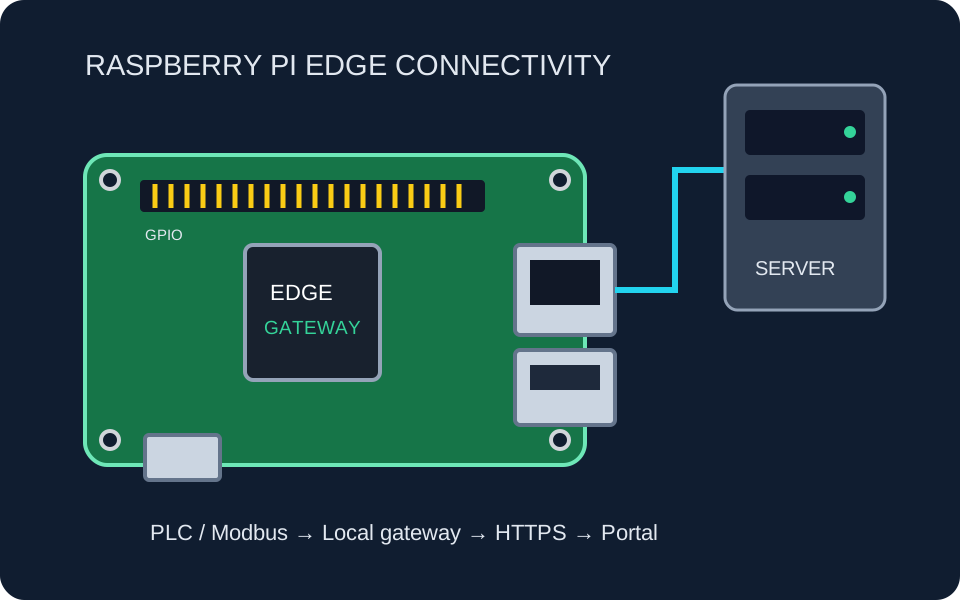
Ethernet, USB, UART, I2C, SPI and GPIO integration where the selected board supports them. Analog signals, RS-485 and industrial voltage levels need suitable converters, isolation and protection.
Modbus TCP/RTU polling, register mapping and unit conversion. MQTT or HTTPS publishing and third-party protocol adapters can be scoped against equipment documentation and license requirements.
Timestamped local records, configurable sampling, buffering and retry logic can be designed for intermittent networks. Retention, disk endurance and reconciliation are agreed during commissioning.
Browser-based status screens, touch-display kiosks and operator-facing information panels. Screen hardware, mounting, access permissions and offline behavior are selected for the installation.
Wired Ethernet, supported Wi-Fi and optional cellular routers or USB modems. Network segregation, firewalls, certificates and remote-access policy are reviewed with the site team.
Authenticated telemetry uploads, device identity, heartbeat and last-reading status. Approved data can be exposed in FlowSync monitoring and linked read-only into the ERP.
Boot services, health checks, diagnostics and controlled software updates can be included. Remote management requires explicit authorization, rollback planning and a maintenance window.
Camera capture, barcode reading or lightweight inference can be evaluated separately. Performance depends on cameras, lighting, model size, accelerators and acceptance testing; it is not a standard included feature.
Machine-data gateways, utility meters, compressor monitoring, remote site dashboards, production information displays and approved laboratory or prototype integrations.
A general-purpose Raspberry Pi is not a safety PLC or guaranteed hard-real-time controller. Emergency stops and protective interlocks remain in appropriately designed local systems. Industrial temperature range, EMC, power-loss protection, redundancy, certification and guaranteed availability require separately selected hardware and testing.
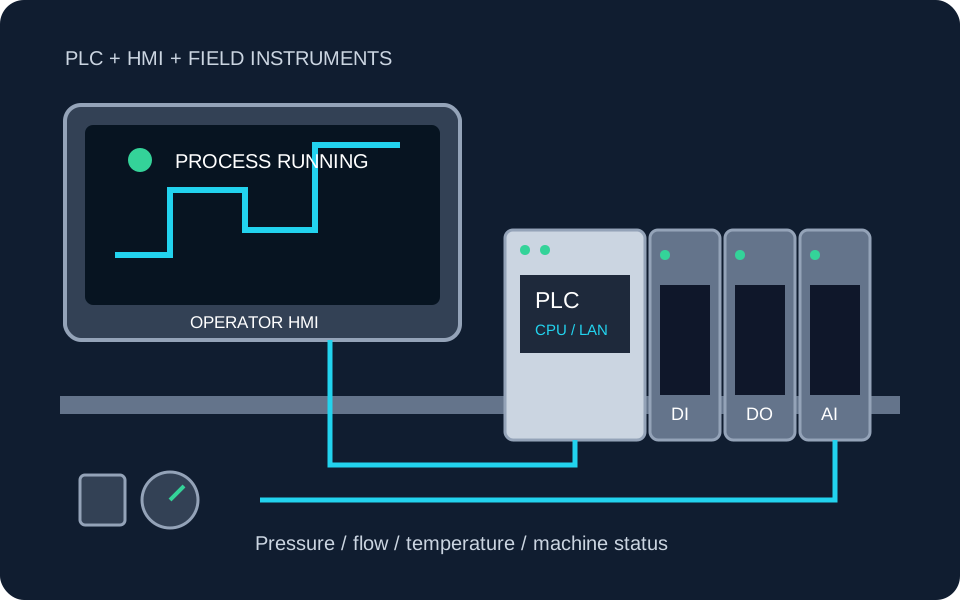
Share your equipment models, signal list, site conditions and connectivity requirements.